Blog

From Head over Heart to Hell and Back

The next big lesson life taught me was to never prioritize my head over my heart.

After establishing myself in the corporate world and still not feeling the fulfilment I had expected, I began yearning, more and more, to leave Germany and return to Poland. This decision didn’t come suddenly. It grew within me, slowly, like a root sprouting from my big toe, reaching up to my hip to give me stability, and eventually making its way to my heart. That’s when I knew: my decision was complete, and it was time to act.

But life, as it often does, tests us the moment we reveal who we truly are. And when you dare to make a decision from your heart, The Mighty sends a trial to make sure you mean it. My test was one of letting go.

I was preparing to move to Poland, and one last thing on my to-do list was a surgery. Nothing major, just a routine procedure, but I was terrified. I was consumed by fear, yet I convinced myself it had to be done before I left.

And so, guided by fear, I stepped into what became the most powerful journey of my life: an emotional and physical apocalypse. I’m not exaggerating when I say I went through hell and back.

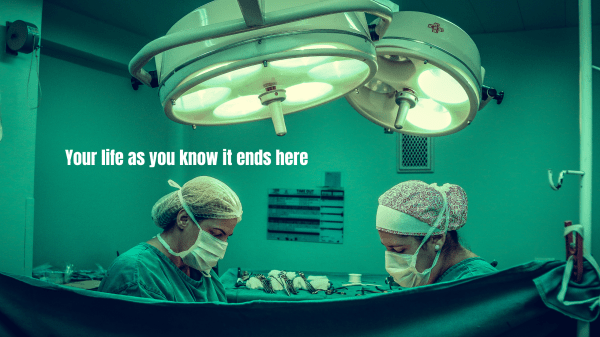
What began as a standard operation escalated into a nightmare. I found myself bedridden in a hospital, unable to eat or sleep for two weeks, and trapped in constant, unbearable pain. I had developed 3 out of 7 possible complications from a procedure that was supposed to be routine and underwent 5 more surgeries in an attempt to fix it.

It’s unimaginable how quickly life as you know it can collapse. You don’t need to know exactly what was done to me, partly because it was inhumane, like being treated as a piece of meat, but the feeling of helplessness and despair was overwhelming. I was just about to start over in a new country, and suddenly, I could barely move.

Most people might have taken this as a sign: “This is a warning. Maybe you’re not meant to go.” But I didn’t see it that way.

Someone close to me told me something that stuck: “You can’t eat cookies and still have them. You have to choose one path and commit to it.”

And in that moment, I knew: I wasn’t going to fight for the life I was leaving behind. I wanted to fight for the life that was still waiting for me. So, I asked my then-boyfriend to sign the lease in Poland, even though I didn’t know if or when I’d be able to leave the hospital bed.

That was the moment I realized healing was my responsibility. No one else could do it for me. I had to focus every bit of my energy on recovering. When I left the first hospital after two weeks, I was barely able to walk. For most of that time, I felt more animal than human: enduring 24/7 inflammatory pain, with the only thing I could actively focus on being my breath.

That’s why they say breath is life. In those darkest moments, your breath is what holds you to this world, what separates you from death.

I endured unspeakable pain, and strangely, I felt the need to go through it. As horrific as the experience was, it gifted me the life I had been dreaming of. That suffering made me appreciate life a million times more. I now lived like there’s no tomorrow, humbly grateful, as if I paid a karmic debt and walked away from death itself.

In September 2015, I was reborn through pain and unwavering faith that something better awaited me.

That same faith, which had quietly taken root inside me, gave me the courage to take that first step toward change. Leaving behind a comfortable and fully functioning life wasn’t easy. But after what I’d been through, there was no going back, because I was no longer the same person who walked into that surgery consumed by fear.

This experience taught me that, in life, you will walk through fire, and no one will be there to save you. But it also taught me something even more powerful: escaping the fire isn’t about resisting it. It’s about setting goals that align with your soul. That alignment is your path out of hell.

And finally, I learned that no matter what life throws your way, it’s your choice how you live every moment. It’s your decision to create a life that’s worth living.

Would I go through it all again?

Hell yes.

Big Pharma – The Corporate Li(f)e

After completing my studies, which I had extended due to the 2008 economic crisis, I was finally ready to find my first real job. Having spent a year working for the German Newspaper Association, I was tired of being a temp for Manpower. In 2010, internships were the norm, and many were working for just €500 a month. I refused to go down that road and instead secured a temporary contract through a staffing agency.

That’s when an opportunity arose at a radiopharmaceutical company. I had never heard of nuclear medicine before, but it felt like we were doing something impactful. Supplying radioactive drugs nationwide was no small mission, and the logistics of transporting radioactive materials on public roads was a challenge in itself.

Even better, the parent company was in France, which allowed me to realize my dream of working not only in English but also in French. Everything seemed to fall into place: my first real job, the beginning of a promising career, and a new relationship that marked the end of my wild student life.

But soon, I learned that not everything that glitters is gold.

The company had previously belonged to Schering before being acquired by Bayer, and it had retained many remnants of Big Pharma culture. People were accustomed to doing very little while earning quite a lot. At that age, I still believed success came from hard work. Having always juggled studying and working, I was used to high pressure and long hours. Now, I found myself surrounded by idleness and toxic workplace dynamics.

There was greed, hostility, and constant envy among colleagues. But the worst part? As soon as our two male colleagues hit the road, the office transformed into a battlefield of petty conflicts. I had never witnessed such open mobbing before. Although I wasn’t the direct target, it affected me deeply. And then there was the schizophrenic colleague who remained employed the entire time I was there, unmanageable and impossible to remove. Every time she returned from a trip to Egypt, she came back unwell, refused to work, and caused complete chaos in the office.

As Assistant to the CEO and Marketing Manager, I became the go-to person for everything. That suited my generalist nature and the dynamic of a small company. But it also made me a human buffer between the older female employees, many of whom had done little personal development. Two of them were especially combative, constantly at odds with each other, and I often found myself stuck in the middle. They represented familiar parental dynamics that I knew all too well from home. At that point, I made a conscious decision about which path to follow.

Each woman embodied a very different leadership style. One was the masculine path, over 60, with 32 years in the company. She was sharp, driven, and incredibly accomplished but also rigid, authoritarian, and inflexible. The other embodied a more feminine energy, emotional, gossipy, constantly dramatizing and shifting blame. Both exhibited these traits in their unhealed, exaggerated forms. It’s probably clear which path I chose.

No one has influenced my career as profoundly as Brigitte. Her mind was quick and clear; her decisions swift and effective. An Aquarius woman with the strength of ten men, she was a powerhouse not only in work but also in culture, lifestyle, and taste. She introduced me to the world of wine, taught me how to work with doctors, and had an impeccable sense of style. We often wore similar outfits, hers, of course, in more luxurious versions. She also drilled into me a belief that you can never spend too much on a good hairdresser or face cream. More than anything, she reinforced my hyper-independence, to walk alone and never rely on anyone.

Though 30 years my senior, she made me understand that it’s not about age. It’s about energy, curiosity, a thirst for growth, healthy habits, and above all, the peace and stability you create for yourself. Looking back now, I realize she was the most significant male figure in my life, shaping me in ways I couldn’t see at the time. During those first three years, I became a lot like her.

During my nearly five years at the company, we achieved a lot. We organized medical congresses that became famous for our stand serving Belgian waffles with cream and cherries that filled entire expo halls with their scent. I became familiar with every major city in Germany and the quirkiest doctor names and streets, like Dr. King on Prince Street in Düsseldorf. We coordinated a nationwide recall of radioactive isotopes and held company events that not everyone appreciated, like our Persian Christmas cooking night.

I visited our colleagues in France, explored Paris and the countryside around Saclay, and experienced the French work culture and savoir-vivre. My perspective on nuclear energy changed. I witnessed Poland establishing its own medical nuclear reactor to gain independence in isotope production. I even met the Iranian billionaire who bought our company and ushered in a wave of corporate transformation.

Eventually, I carved out a career in Quality Assurance and Regulatory Affairs, but my relationship began to unravel. When you’re young and just starting your career, there’s a strong desire to prove yourself, to achieve. We were both driven by that impulse. My partner was a construction engineer on the delayed and debt-ridden BER airport project, and I was fighting more against toxic personalities and inflated egos than facing real professional challenges.

In the end, my dream of a fulfilling career didn’t come true. But I did see people’s true colors. When I got promoted and received a new Audi and iPhone, some colleagues simply stopped talking to me. It was as if they expected me to become arrogant or untrustworthy overnight. But guess what? I didn’t change. I was still the same person, just one illusion poorer: that career success brings happiness, and that once you’ve made it, you can build the perfect life.

My relationship collapsed, and my job became the only thing holding me together. I’ll never forget the day I called Brigitte in tears, telling her I couldn’t come to work because the man I’d supported through his workaholism had broken up with me. She just said, “Beata, I’m not surprised by anything when it comes to men. Take your time.” I returned to work the next day, but something had changed. That life no longer felt like mine.

Everything looked perfect on paper, but it didn’t feel right. It was a construct built on societal expectations and old conditioning. I had followed a path designed to make others proud, not myself. My life had started to follow the natural flow: growth, expansion, and ultimately, destruction. It was a wake-up call. At 31, I was collecting the fragments of my first major life crash and just beginning to grow into the person writing these lines today.
Corporate Dreamland

For many people, the concept of work-life balance only became a serious consideration during the COVID-19 pandemic and its aftermath. But when I look back, my journey with “work-life” actually began long before I entered the workforce.

As a student, I took a job at an American corporate law firm as a “Late Night Secretary.” The title may have sounded amusing, but the work was serious, and exactly what I was looking for at that point in my life. Our office was perched on the 20th floor in the heart of Berlin’s Mitte district, with a direct view of the German parliament. While they were making the decisions, we were executing the moves behind the scenes.

Driven and ambitious, I wanted to be part of something larger, something with purpose and intensity. This firm was the perfect fit. It only accepted the best of the best and remains one of the most prestigious firms to this day. Having previously worked only in retail, I often wondered how I landed there so early in my career, stepping into what felt like a corporate dreamland.

During an internship at the German Parliament (yes, I once aimed for the European Commission and considered becoming a foreign language correspondent), I met my dear friend Margareta. Half Austrian, half Bavarian, born in Panama, she was brilliant, the top law student in her year. But instead of pursuing a traditional legal career, she chose to become a secretary, putting her family first. She introduced me to the law firm, as a close friend of hers was already working there. That connection changed everything.

This was the gold standard of corporate life. Even back then, I knew that working in such an environment would set my expectations sky-high, maybe even ruin me for anything less. The level of professionalism, structure, and organization was second to none. Every job I had afterward felt like working in an amateur league by comparison.

But such excellence came at a cost. Fitting in was essential. We were trained in how to speak, how to dress, and how to navigate the firm’s culture. Our shifts usually ran from 5 to 10 PM, though during court submission deadlines, we often stayed until midnight.

I thrived on the big projects, the headline-making ones. I typed 30-page dictations and often knew what was coming before the news broke. We worked on high-stakes mergers and acquisitions, including the Volkswagen-MAN-Scania saga. MAN attempted to acquire Scania, but Volkswagen and Swedish stakeholders blocked it. It was a corporate chess game, unfolding in real time, until Volkswagen ultimately secured a 30% stake in MAN and a significant part of Scania, aiming to consolidate their truck fleet.

Another major project was the rollout of Germany’s unified Deposit Return System (DPG) in May 2006. Yes, that was us. This initiative, still in effect today, introduced a standardized 25-cent deposit on almost all single-use PET bottles and cans, refundable through automated machines across the country. It impacted every single one of Germany’s 80 million citizens. That’s the kind of work I wanted to be part of, meaningful, far-reaching, and real.

I didn’t want to play small, and I definitely didn’t want to engage in the politicking I’d witnessed in the German Parliament. I wanted to stand alongside the big players and make my mark. It wasn’t even about validation, though perhaps partly about feeding my ego and masking a harder truth: that the sense of power I was chasing came with a steep price.

Because, like everything, this job had another side to it. Sure, these men were earning in an hour what I made in a month, but many only saw their families on weekends. The pressure to perform was immense, and they had to find ways, some healthier than others, to cope with it. They aged differently than my father, who had spent his life doing physical labor. Stress had carved itself into their faces. I saw them more than their own wives did, and I couldn’t see myself becoming one of them.

I believe our early experiences, just like early relationships, help steer us. They teach us not only what we want, but also what we don’t want. I’m incredibly grateful for that time. It allowed me to see behind the curtain before I fully launched my career. I didn’t waste years chasing someone else’s dream.

I got to be part of something impactful. I worked with the elite and realized they were just ordinary people. And I came to understand that corporate life is a massive machine, where each cog must turn perfectly for the system to function.

But I also knew I didn’t want to be a cog.

There was so much more waiting, more to explore, more to build. And I knew I was only at the beginning of that journey: a search not just for balance in my work life, but for true fulfillment.

This all happened before my official career had even begun. In the next part of this series, I’ll take you through my first job after graduation and what came next.

Becoming the Natural Woman: The Ultimate Rebellion in a Performative World

Not long ago, women were expected to fulfill rigid standards of being a “good” woman: dutiful wife, devoted mother, obedient daughter. In a world where societal norms and others’ opinions defined a woman’s worth, conforming felt like the most natural thing. After all, society survives through sameness, through people fitting into roles.

Today, we’re lucky to live in different times. We can choose how we dress, who we love, how we earn, and how we live. Life has opened up spaces that used to be off-limits to women. The once “normed” woman has become the modern woman, one who, paradoxically, is now expected to handle even more, aided by technology and pressure alike.

Yes, we have choices now. But does that mean life has actually become easier? I asked myself this often while still living what I now call a “male lifestyle.” What did emancipation really give us if we just moved from one box: home and children, into another: career and constant striving? Both still ask us to adjust, to perform, to play by rules we didn’t write.

I was around 32 when I reached a big career milestone. I got the promotion I had worked so hard for, and I was surprised by how little it meant. No joy, no lasting fulfillment, just the quiet realization that I had become hard, assertive, and goal-driven. I had shaped myself around women who prioritized success over softness, and I realized the image I had built of myself was no longer mine. It was painted in someone else’s colors.

I knew I needed to change. But where do you start when your whole life has been shaped by ideals that don’t resonate anymore? By chance, I watched a TV program about a woman in Russia who was teaching women how to reclaim their femininity. These were successful, strong women, just like me, who had lost their softness. And I thought, I want that too. I had buried my feminine side for years, and suddenly, I was ready to let her back in.

That turning point came as I moved back to my home country, Poland, where traditional gender roles were still more visible. It was easier there to tap into my feminine energy. But femininity isn’t about how you look, it’s about how you are. It’s about slowing down, softening, being. Letting others play a role in your life without assigning every part. It’s about letting go of control and learning to trust your own rhythm: your intuition, your feelings, your heart.

I started building my life around meaningful relationships instead of strategic ones. My interest in people deepened, and with it, my emotional capacity. I noticed I was moving away from people who only liked me when I was convenient, but shied away from my emotional depth. I started listening to my own natural rhythm and diving into my creative nature. I began hearing that small voice inside, the one I had ignored for so long. And I became louder, less filtered, less polished. I felt more like me.

I spent most of my 30s living in this feminine space, and in that time, I did things I can barely believe now. Why? Because I trusted life. I surrendered. I let my intuition lead. I walked away from artificial control (like birth control) and returned to the cyclical, raw rhythm of my body. I learned how to ride emotional waves instead of fearing them. Reclaiming my wild feminine nature was the most loving thing I could do for myself.

Looking back, that phase of my life was about becoming the woman I was always meant to be. It was about healing, maturing, rediscovering my essence, and finally letting go of being the “good girl.” When a woman speaks her truth, she becomes a threat to those who don’t. Reclaiming my power and stepping away from the comfort of other people’s expectations came with a cost. But when external validation stops mattering and you let your true voice take the lead, you understand something profound:

Being liked is optional.
Being valued is everything.

In a world where everyone wants to go viral, I chose to be real.

What They Don’t Teach Us About Discipline

Discipline is often viewed as something restrictive, especially in the early stages of life. But as we grow and gain perspective, we begin to see it for what it truly is: a path to liberation.

As children, we are shaped by the firm hands of authority, parents, teachers, caretakers, who believe that instilling discipline early on gives us an advantage in life. While this perspective isn’t entirely wrong, it misses a deeper truth.

Today, we understand that childhood should also be filled with light-heartedness, play, and joy. Interestingly, a recent study suggests that if you want your children to grow up intelligent and capable, it’s better to teach them music than coding.

I was raised to be an achiever, someone tasked with fulfilling the unmet ambitions of my mother. As a result, I learned early on that my value was tied to achievement. For a while, life seemed easy. I followed the expected path, met the milestones, and checked the boxes. But there was a hidden cost.

It’s difficult to feel fulfilled when you’re always chasing the next goal. Once you reach the peak, all you can see is the next mountain. Nothing is ever enough. You’re like the donkey endlessly chasing the carrot tied to its own back: always striving, never arriving.

On the other hand, what happens when discipline is lacking? You begin to see it manifest as scattered, “leaky” energy—gluttony, overspending, compulsive behaviors, gambling, and impulsive indulgence. These aren’t just bad habits; they’re symptoms of an inner imbalance. Without discipline, you’re constantly feeding the angry wolf within.

“Everyone wants to heal until the medicine shows up in the form of discipline.”
— Hippocrates

No one tells us that discipline is actually the highest form of self-love.

As children, we’re subjected to discipline imposed by others. That external control becomes our internal voice, and we assume we’ve learned discipline. But there’s a world of difference between the discipline imposed on us and the self-discipline we choose for ourselves.

True discipline, the kind that leads to freedom, comes from within. It’s the structure we build for ourselves, on our terms, and for our highest good. This kind of discipline not only frees us from self-destructive behaviors but also teaches us what love looks like in adulthood.

Unlike the unconditional love we received as children, where we were often shielded from consequences, adult love requires boundaries, effort, and consistency. Discipline transforms love from a fleeting feeling into a deliberate practice.

What feels good in the moment can be completely wrong in hindsight. Discipline teaches us to recognize that difference. It helps us build inner strength and resilience, because we learn to trust ourselves. We keep our word. We show up. We become our own reliable ally.

Putting yourself first and showing up for your life won’t be possible without discipline. It’s not just about being rigid or serious. Discipline helps you stand firm, stay grounded, and face life’s challenges with confidence.

I’m not writing these words because I read them in a book. I write them from experience. I grew up under intense control and pressure, and for much of my adult life, I resisted discipline entirely. I was on the opposite end of the spectrum.

But learning self-discipline as an adult has been one of the hardest, and most rewarding paths I’ve ever taken. Paradoxically, the more disciplined you become, the easier life becomes.

If you’re on the fence about discipline, if it still feels like punishment or pressure, consider that it might actually be your pathway to peace. Discipline isn’t about control; it’s about care. It’s a declaration that your life matters enough to shape intentionally.

When you begin to practice discipline not as a demand, but as a devotion to yourself, everything starts to change. Bit by bit, you stop chasing the carrot, and realize you were the one holding the reins all along.

Blog at WordPress.com.

Up ↑